
Lighting Control Installers

Home Lighting Control Systems — Design and Installation
Residential Lighting Control, Perfected Since 1998
A home lighting control system brings every light, blind and curtain in a property under one coherent interface. A single button recalls the exact lighting a room needs for any activity, lighting follows the natural rhythm of the day automatically, and a home that is away on holiday can convincingly look occupied every evening it is empty. Lighting control is the service we recommend first on every new build and major renovation, and the one we would install before anything else if a client’s budget allowed only one system: nothing else changes how a home feels, looks and functions as immediately, or saves as much energy as unobtrusively.
We design, install and programme residential lighting control on Lutron HomeWorks QSX and Crestron, including DALI lighting and the upgrade of older KNX, Mode, iLight, Vantage and Rako systems. We are certified Lutron dealers and Crestron Dealers of Distinction, 5 x Crestron Integration Award winners (a record unique in EMEA), and one of those awards was for Brilliant Lighting Control & Design. We have been designing, installing and programming lighting control systems since 1998 across London, Cheshire, Surrey, Dubai and the French Alps. If you want to understand the technology first, our guide to what a lighting control system is explains the types, the parts and the benefits in plain English.

Lutron

Crestron

Design

Climate

Smart Home
What a Home Lighting Control System Replaces
A conventional home has a switch for every light, and that switch only does one thing: on or off, sometimes with a basic rotary dimmer. A lighting control system replaces every one of those switches with a single keypad, but the keypad itself isn’t the point. The point is what one button press can now do: recall a precise, pre-set level for every light in the room simultaneously, in the exact combination that took a designer’s time to get right once, recallable forever after without anyone needing to touch a second switch.
“Reading” dims the room to a level that flatters a book and a face at the same time. “Entertaining” brings up accent lighting and leaves the centre of the room slightly darker. “Cleaning” brings everything to full brightness so nothing gets missed. “Goodnight” turns off the whole floor, closes the blinds and leaves a low path of light to the stairs. The keypads themselves are fully configurable and custom-engraved, never a generic, unlabelled grid of buttons that means nothing until you’ve memorised it, so guests and visitors can use the system without instruction.
How a Whole-House Lighting Control System Is Built
Behind the keypads, a whole-house system has four layers. At the centre is a processor: a Lutron HomeWorks QSX processor or a Crestron control processor, which holds every scene, schedule and integration. The processor drives the dimmers and switching modules, which on a wired system sit together in lighting racks or DIN rail enclosures in a plant room or cupboard rather than behind each wall switch. Each lighting channel is wired back to its own dimmer; a channel can be a single light or a group of several, and the more finely a room’s lighting is split into channels, the more precise the eventual control.
The third layer is the controls people actually touch: keypads wired in low-voltage cable, wireless keypads, touchpanels, iPads, handheld remotes and the app. Local keypads in different areas of a room control what is nearby, alongside a global all-off button for the whole space at night. The fourth layer is the inputs that make the house respond on its own: astronomical time clocks that know sunset at the property’s location, occupancy sensors in cloakrooms and plant rooms, and links to the alarm, the heating and the AV system.
On larger properties we design the rack topology for the building rather than forcing every circuit back to one cabinet, with a dedicated distribution board per building where appropriate and every structure reporting to a central QSX or Crestron processor. On the award-winning Derby new build, six distributed lighting racks provide redundancy and clean cabling across more than 200 channels and 350 Crestron LED fittings.
Lutron HomeWorks QSX or Crestron — Choosing the Platform
The two platforms we specify for home lighting control are Lutron and Crestron. The decision usually comes down to the property, the rest of the systems in the house and the keypads and light sources the interior calls for.
Lutron HomeWorks QSX is our recommendation for lighting and shading in demanding homes. It has unlimited zones, access to the full Lutron designer keypad range, Alisse, Palladiom and Avienna, in dozens of finishes, native integration with Ketra full-spectrum lighting and Lumaris tunable white tape, and the widest range of Lutron motorised blinds and curtains.
Crestron lighting suits homes where Crestron already runs the AV, climate and security, so lighting sits on the same processor as every other part of the house. Crestron DIN rail dimmer modules support dimming and switching of virtually any lamp type, wireless keypads make retrofits practical, and DALI lighting is now configured directly in Crestron Home OS 4.6 through the DIN-DLI interface, with no separate lighting controller and no separate app. On the most demanding projects we combine HomeWorks QSX lighting and shading with Crestron home automation, giving one bespoke control interface for lighting, AV, climate, security and more. If you are unsure which suits your home, we offer free consultations at our London or Cheshire offices, or at the Lutron Experience Centre in London.
Wired, Wireless or Both
On a new build or a renovation that strips back to the structure, a wired system is the best foundation: every lighting circuit is home-run to the lighting rack, keypads run on low-voltage data cable, and nothing depends on radio coverage. This is why we recommend specifying lighting control at the same stage as a renovation or extension rather than retrofitting it afterwards wherever a wired system is the right choice. The lighting schedule, keypad positions and cabling are agreed with the electrical contractor at first fix, while walls and ceilings are open.
Where walls can’t be opened, wireless control does the same job. On a Kensington mews house bought with a traditional switched lighting system, Crestron wireless dimmers replaced each light switch, giving every room full scene control without a single cable pulled. In Wimbledon, a failing KNX system installed by the original developer was replaced with mains-powered Crestron wireless keypads that form a mesh network, using the existing cabling only for power: nineteen keypads now control 30 lighting channels from centralised DIN rail dimmers, and the unreliable data cabling is no longer part of the system.
Most of our projects end up as a hybrid. HomeWorks QSX combines wired and wireless devices on the same system, so a wireless keypad can go wherever cable can’t reach, and Lutron Palladiom wire-free shades run on batteries that last three to five years, with no new wiring at the window. The choice is made room by room, not once for the whole house.
Dimming, DALI and Why LED Retrofits Go Wrong
One of the most common service calls we receive is on systems we did not originally install: an electrician has swapped halogen lamps for LED on a like-for-like basis and the result flickers, buzzes, or won’t dim below a certain level. This isn’t a fault with LED technology; it’s almost always a mismatch between the dimming protocol the original switches were built for and the electrical behaviour of a modern LED driver. Older leading-edge dimmers, designed for resistive halogen and incandescent loads, are frequently incompatible with the capacitive characteristics of LED drivers, which generally need trailing-edge dimming to run cleanly.
On larger or more sophisticated installations we specify DALI, a digital, individually addressable, bidirectional protocol that lets the system query every fixture’s actual status and detect failures remotely, rather than relying on guesswork across hundreds of circuits. We also work with KNX: we integrate KNX air conditioning into Crestron, as on our Dubai estate, and we replace failing KNX lighting systems, as in Wimbledon. We check every driver’s specification against the dimming method in place before any retrofit or, far more often on a serious project, specify the protocol and the fittings together from the outset. Read our full technical guide to dimming protocols →
Keypads, Touchpanels, the App and Voice
The keypad is the part of the system the household touches every day, so we treat it as part of the interior. Lutron’s Palladiom, Alisse and Avienna keypads are objects of considerable design quality, available in dozens of finishes and flush-mounted to sit neatly beside sockets and switches, while Crestron’s Horizon keypad family shares its design language with the Horizon thermostat, so a wall of climate and lighting controls reads as one considered system. Every keypad is engraved with scene names, and we keep the button logic consistent from room to room so a guest can walk into any room and find the same layout.
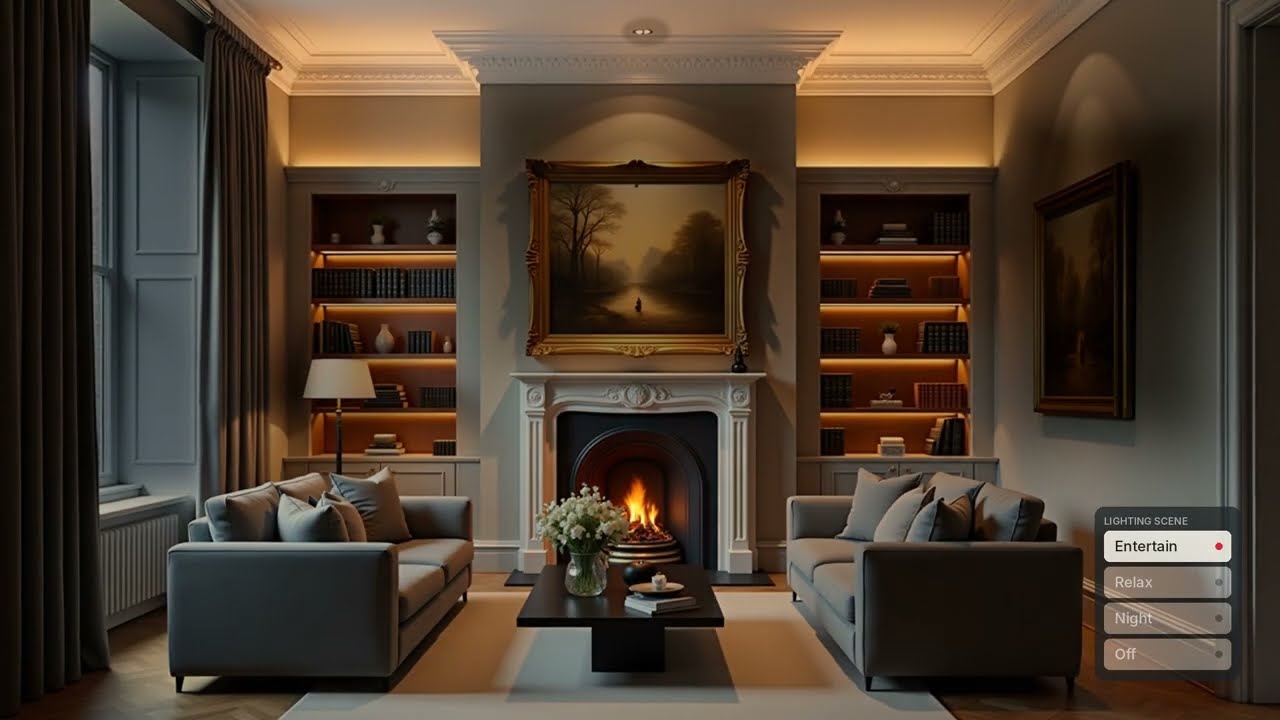
The video shows what a single scene button does in a drawing room: each circuit, from the cornice cove and bookcase lighting to the picture lights and the lamp, dims on its own and fades in turn as the room moves from Off to Entertain, Relax and Night.
Alongside the keypads, the same scenes are available from wall touchpanels, iPads, handheld remotes and the Lutron or Crestron app, which also gives remote access when you are away, so you can check the house is dark or bring the lights up before you arrive. Voice control with Amazon Alexa and Apple Siri is available on both platforms for the households that want it.
Circadian Lighting with Ketra, Lumaris and Rania
Dimming brightness is only one part of what a current Lutron system can do. The more significant development of the past few years is full-spectrum and tunable lighting, adjusting not just how bright a light is but its colour temperature and, on the most capable systems, its precise spectral composition. We design and install circadian lighting on HomeWorks QSX, so the light in a home moves with the day: bright and clear when you want to be alert, deeply warm and low when you are winding down.
Ketra is Lutron’s flagship full-spectrum system, covering 1,400K to 10,000K with access to 16.7 million colours and Color Lock technology that keeps colour output accurate over the fixture’s lifetime. Its Natural Show tracks the position of the sun at a property’s GPS coordinates and shifts colour temperature and intensity through the day automatically. Rania delivers a three-channel tunable white range (1,800K–5,500K) with a CRI above 90, built on the same colour science at a more accessible specification, and Lumaris is Lutron’s tunable white and RGB tape light family for coves, joinery and architectural detail. Ketra requires HomeWorks QSX, and all three are designed into the ceilings and joinery before first fix rather than added afterwards.
Motorised Blinds and Curtains in the Same System
Adding curtains and blinds to a lighting control system creates a truly automated home: curtains and blinds close automatically when darkness falls and can open at sunrise, and a holiday mode follows your usual pattern rather than running on a single fixed timer. Advanced shading control also helps regulate temperature naturally; if light levels and temperature are rising on one side of the property, the system can close blinds incrementally to manage solar gain before air conditioning is needed, and the same system protects fabric, furniture and artwork from the bleaching effect of direct sunlight.
Lutron is the world’s largest manufacturer of motorised window treatments, and integrating shading through the same Lutron system as the lighting, rather than a disconnected third-party shading system, consistently produces a better result: quieter motors, more reliable scene integration and one system to commission rather than two. Our page on motorised blinds and curtains covers roller, Roman and curtain tracks, sun tracking and wire-free options in detail.
Lighting That Works With the Rest of the House
Lighting control earns its keep when it stops being a separate system. In the Kensington mews house, the lighting is written into the same control logic as the alarm, so arming the house on the way out switches off every light and the AV, and disarming it brings a chosen welcome-home scene straight back before the front door has closed. External lighting switches on at sunset and off at a time the household chooses, and a holiday mode records the household’s usual lighting activity and replays it during absence to simulate occupancy.
The same scenes can set the heating and air conditioning, start music in the kitchen through the multi-room audio system, or dim the room and lower the blinds when a film starts in the media room. Because everything shares one processor and one set of scenes, the house behaves the same way whether it is controlled from a keypad, the app or an automatic schedule.
From Design to Handover
Every project starts with a survey and a conversation about how the household lives, followed by a lighting design and a channel schedule: which lights are grouped, where every keypad sits, which scenes each button recalls and how the shading is integrated. Dimming types, keypad positions and the power and control cabling for every blind and curtain are agreed with the electrical contractor at first fix, along with the pockets, pelmets and recesses that let shading disappear into the architecture. Getting those details right early is what makes the finished system look effortless.
At second fix, once decoration is complete, we install the keypads, touchpanels and lighting racks, and commission the system. Every Crestron and Lutron system we commission starts as a set of flat reference scenes, 100%, 75%, 50% and 25%, and we only finalise the real scenes once decoration and furniture are in their final positions, because lighting a finished room is a fundamentally different exercise from lighting an empty shell. At handover we walk the household through every scene and interface, and stay on hand afterwards through our aftercare and maintenance service.
New Builds, Renovations, Listed Buildings and Single Rooms
Lighting control can be installed in a single room during a renovation or extension just as effectively as across an entire estate. The modern open-plan kitchen, dining and living room is a particularly strong case: a single large space genuinely benefits from a system that gets the lighting right for cooking, dining and watching television without those three activities fighting each other for the same fixed set of switches.
Period properties and listed buildings need a lighter touch. Where listed building consent rules out chasing new cable, wireless keypads and wire-free shading give full scene control without disturbing historic fabric, and keypads can be specified in finishes that suit the interior rather than fighting it. New builds give the most freedom: the lighting design, the fittings and the control system are specified together from the outset, which is how the Derby project became the first UK installation of Crestron LED fittings end to end, from the LED in the ceiling to the keypad on the wall.
Built for Scale — Estate-Wide Lighting Across Multiple Buildings
Where a typical residential lighting project involves a single distribution board, our largest projects call for something closer to a small building-services installation. On country estates and multi-building properties, we design distributed rack architecture rather than routing every circuit back to one central cabinet: typically a dedicated equipment rack per building, a further rack per floor on larger structures, and one or two more racks serving the garden and grounds. Every rack is networked back to the same control system, so the property operates as a single installation: one set of scenes, one interface and one point of programming, however many structures or hundreds of circuits are involved.
Our flagship example is a private estate in Dubai, where eight Crestron processors manage over 400 individual lighting loads across two villas and extensive grounds, working together to deliver a single, seamless experience throughout the property. A whole-estate scene can switch on the exterior lighting, close the blinds and set every building to its arrival configuration at once. View the full Dubai estate case study →
Bespoke Lighting Design — High End Lighting Solutions
Well-designed lighting transforms spaces into warm, inviting environments and highlights architectural and interior features, and of every service we provide, lighting design and control has the single largest effect on how a finished room actually feels. That is why we like to be involved at the earliest possible stage of a new build or retrofit, designing a lighting scheme that adds warmth and character rather than simply illuminating a floor plan. Our scenes use established techniques that vary room to room: LED strip lighting to illuminate bookshelves, picture lights to enhance artwork, directional spotlights to draw out architectural detail.
One advantage worth understanding properly: a lighting control system lets a fitting be illuminated even when its light output isn’t required. Dimming a ceiling downlight to 10% produces negligible usable light, but the glow from the fitting itself adds warmth and depth that a switched-off downlight simply cannot. We partner with manufacturers who produce the highest quality fittings available, ensuring consistent colour temperature from every lamp in a room and reliable dimming across the full range; the large majority of our fittings are LED, with a rated life around 50,000 hours. For design, specification and installation working together from the outset, see our residential lighting design service.
Upgrading or Taking Over an Existing Lighting System
Many of our lighting projects start with a system someone else installed. We upgrade Mode, iLight, Vantage, Rako and KNX systems to modern Crestron or Lutron equivalents, using existing cabling wherever possible, and replace legacy Lutron HomeWorks Interactive, Illumination and GRAFIK Eye systems with HomeWorks QSX, often keeping the existing keypads and replacing only the processor and dimming modules behind the wall. We assess the existing cabling before recommending any upgrade path.
Where a system is sound but its original installer has gone, we take it over, recover or rewrite the programming and support it from then on. Our Lutron maintenance and support and Crestron maintenance and support pages explain how that works, and our article on upgrading a Lutron or Crestron lighting control system covers the options in more detail.
Home Lighting Control FAQs
What is a home lighting control system?
A home lighting control system replaces individual light switches with programmable keypads, touchpanels and an app, all connected to a central processor. One button recalls a pre-set level for every light in a room, and the system can run lighting, blinds and curtains automatically by time of day, sunset or occupancy.
What does a lighting control system replace?
It replaces the switch for every light with a single configurable keypad. One button press recalls a precise pre-set level for every light in the room at once, such as Reading, Entertaining or Cleaning, and each keypad is custom-engraved so it is never an unlabelled grid of buttons.
Should I choose Lutron or Crestron for lighting?
We specify both. Lutron HomeWorks QSX is our recommendation for lighting and shading in demanding homes, with the designer keypad ranges and Ketra. Crestron suits homes where Crestron already runs the AV, climate and security, and on the most demanding projects we combine HomeWorks QSX lighting with Crestron home automation for one control interface.
Can lighting control be installed without rewiring?
Yes. Wireless dimmers and keypads replace existing switches and use the existing cabling for power only, as on our Kensington and Wimbledon projects. HomeWorks QSX also mixes wired and wireless devices, so wireless keypads and wire-free shades can go where new cable cannot.
What does a lighting control system cost?
It depends on the number of lighting channels and keypads, whether the system is wired or wireless, the keypad finishes, any tunable white or Ketra lighting and how much shading is included. We can only give a meaningful figure once we have seen the property and discussed the design.
Do you install DALI and KNX lighting control?
Yes. We specify DALI on larger and more sophisticated installations because every fixture is individually addressable and reports its status, and Crestron Home now configures DALI directly. We integrate KNX systems such as air conditioning into Crestron, and we replace failing KNX lighting systems with Crestron or Lutron.
Can I control my lights from my phone or by voice?
Yes. Every scene is available from the Lutron or Crestron app as well as the keypads, including remote access when you are away from home. Voice control with Amazon Alexa and Apple Siri is available on both platforms.
Can a lighting system also control blinds and curtains?
Yes. Lutron and Crestron both control motorised blinds and curtains through the same system as the lighting, so a single button can set the lighting and the shading for an activity, and blinds can close automatically at sunset or to manage solar gain.
Can lighting control make my home look occupied when I am away?
Yes. A holiday mode records your usual lighting activity and replays it while you are away, and blinds and curtains can follow the same pattern rather than running on a single fixed timer.
Can you upgrade an old lighting control system?
Yes. We upgrade Mode, iLight, Vantage, Rako and KNX systems to modern Crestron or Lutron equivalents, using existing cabling wherever possible, and replace legacy Lutron systems with HomeWorks QSX, often keeping the existing keypads.
Can lighting control cover an estate with several buildings?
Yes. We design distributed lighting racks for each building, all networked back to one control system, so the whole estate has one set of scenes and one interface. Our Dubai estate runs over 400 lighting loads across two villas and the grounds.
Do you offer lighting design as well as control?
Yes. For the full lighting package, with fittings, design, specification and installation working together from the outset, see our residential lighting design service.
Lutron Lighting Control → · Lutron HomeWorks QSX → · Crestron Lighting → · Circadian Lighting → · Motorised Blinds → · Lighting Design → · Contact Us →